
Manufacturing and the Skilled Labor Crisis: How AI Compresses Expertise and Stabilizes Performance
Updated: Jul 28
Manufacturing faces structural skilled labor shortages. Discover how AI-native execution systems compress expertise, accelerate onboarding, and stabilize quality and safety performance.
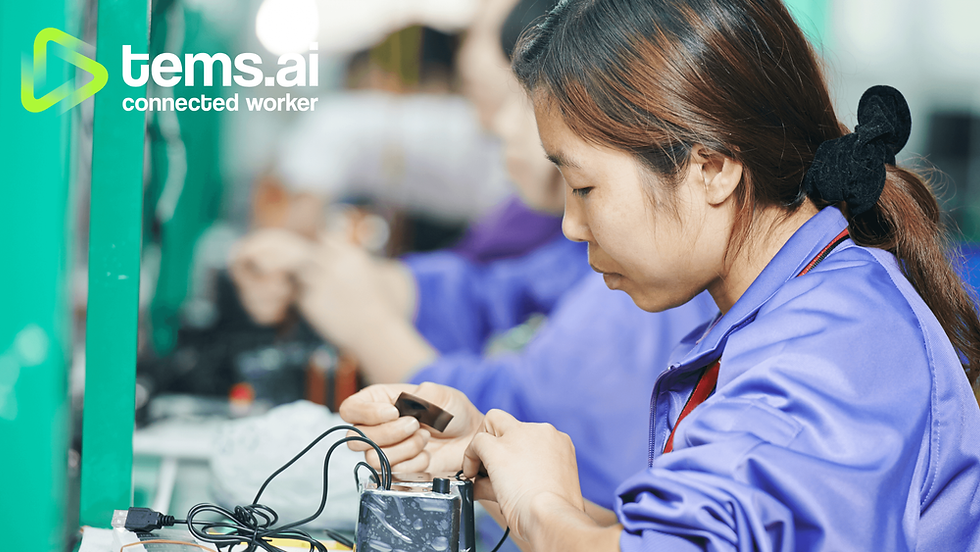
Introduction: A Structural Crisis, Not a Temporary Gap
⠀⠀
Manufacturing is not experiencing a short-term hiring challenge. It is facing a structural labor shift.
⠀⠀
Across Europe and North America, data consistently shows:
15–25% vacancy rates for skilled technical roles
6–9 months onboarding periods for complex production roles
Rising wage pressure without equivalent skill availability
Increased safety and quality risk due to inexperience
⠀⠀
Demographics amplify the issue:
Aging workforce nearing retirement
Reduced vocational enrollment in technical trades
Competition from other industries for digital talent
⠀⠀
Waiting for labor markets to “recover” is not a viable strategy. The solution must be operational.
⠀⠀
Why Traditional Responses Are Insufficient
⠀⠀
Common responses include:
Increased recruitment spending
Apprenticeship programs
Overtime reliance
Cross-training initiatives
⠀⠀
These are necessary but insufficient. They do not address the structural asymmetry: The complexity of manufacturing is increasing while experience density is decreasing.
⠀⠀
High-mix production. Tighter compliance standards. More automation layers. Faster product cycles. Skill compression is required.
⠀⠀
The Concept of Expertise Compression
⠀⠀
Expertise compression means reducing the time required for an operator to perform at high competence levels.
⠀⠀
Historically, expertise developed over:
Years of machine exposure
Repeated changeovers
Multiple deviation recoveries
Tacit knowledge accumulation
⠀⠀
AI-native execution systems compress this timeline by embedding guidance directly into workflows. Experience becomes system-supported rather than tenure-dependent.
⠀⠀
AI as In-Shift Coaching
⠀⠀
Traditional training separates learning from execution.
Classroom modules
LMS-based certification
Periodic workshops
⠀⠀
In reality, learning happens during production. AI-native platforms provide:
Step-by-step guidance during changeovers
Context-aware prompts during startups
Risk-based verification when drift occurs
Escalation logic during abnormal states
⠀⠀
This is in-shift coaching. Learning and execution converge.
⠀⠀
Accelerating Onboarding Without Compromising Quality
⠀⠀
New hires often struggle with:
Understanding machine nuance
Recognizing early fault indicators
Sequencing tasks efficiently
Navigating digital systems
⠀⠀
AI-native execution reduces onboarding friction by:
Adapting instruction depth to skill level
Providing multilingual contextual guidance
Reducing search time for procedures
Triggering verification at critical control points
⠀⠀
Plants report:
Faster time-to-competency
Reduced first-month error rates
Lower scrap during new hire ramp-up
Improved safety adherence
⠀⠀
The onboarding curve becomes flatter.
⠀⠀
Stabilizing Performance Under Pressure
⠀⠀
Labor shortages often force:
Increased overtime
Cross-line coverage
Temporary staff deployment
⠀⠀
This introduces execution variability. AI-native platforms mitigate variability by:
Standardizing task sequencing
Enforcing mandatory quality gates
Detecting deviation patterns early
Providing micro-guidance during execution
⠀⠀
The result is not perfection. It is predictability. Predictability stabilizes OEE and safety performance.
⠀⠀
Changeover Risk in High-Mix Environments
⠀⠀
High SKU proliferation intensifies skill demands. Changeovers require:
Accurate parameter setting
Precise sequence adherence
Quality validation
Rapid stabilization
⠀⠀
Inexperienced operators increase:
Setup waste
Scrap during first runs
Extended downtime
⠀⠀
AI-native execution systems:
Guide changeovers step-by-step
Verify critical parameters automatically
Learn from previous stabilization patterns
Shorten ramp-up duration
⠀⠀
This reduces dependency on individual mastery.
⠀⠀
Safety Implications of Skill Gaps
⠀⠀
Skill shortages correlate with:
Increased near-miss incidents
Inconsistent safety compliance
Higher error probability under stress
⠀⠀
AI-native safety enforcement supports:
Mandatory check completion
Real-time abnormality detection
Context-triggered escalation
Digital audit traceability
⠀⠀
Safety becomes system-enforced rather than memory-dependent.
⠀⠀
The Economic Impact of Labor Shortages
⠀⠀
Labor shortages impact:
Downtime costs
Scrap costs
Quality claims
Overtime premiums
Training overhead
⠀⠀
When expertise compression reduces:
Downtime during transitions
Error frequency
Onboarding duration
⠀⠀
Financial performance improves directly. Connected worker initiatives become P&L levers.
⠀⠀
AI Does Not Replace Skilled Workers, It Multiplies Them
⠀⠀
A common misconception is that AI replaces labor. In reality, AI-native execution:
Amplifies experienced operators
Supports less experienced staff
Distributes expertise across shifts
Reduces burnout under pressure
⠀⠀
The best operator’s knowledge becomes accessible to the entire workforce. This increases capacity without increasing headcount.
⠀⠀
Workforce Resilience as Competitive Advantage
⠀⠀
Plants that rely on individual heroics remain vulnerable. Plants that embed expertise into systems achieve resilience.
⠀⠀
Resilience includes:
Stable performance despite turnover
Predictable onboarding cycles
Reduced dependency on specific individuals
Lower quality volatility
⠀⠀
AI-native execution systems become strategic infrastructure.
⠀⠀
Enterprise Deployment Strategy
⠀⠀
A practical approach includes:
⠀⠀
Phase 1: Target High-Risk Processes
Changeovers
Startup stabilization
Critical quality checks
⠀⠀
Phase 2: Expand to Onboarding and Skill Inference
Adaptive guidance
Real-time skill telemetry
⠀⠀
Phase 3: Integrate with MES and Maintenance Systems
Triggered workflows
Risk-based audits
⠀⠀
This phased model demonstrates early ROI while scaling sustainably.
⠀⠀
Strategic Questions for Leadership
⠀⠀
What percentage of production variability is skill-related?
How long does it take a new hire to reach stable performance?
How vulnerable are operations to retirements?
How much scrap occurs during transitions?
⠀⠀
If variability correlates with experience gaps, AI-native execution is a structural solution.
⠀⠀
The Long-Term Outlook
⠀⠀
Labor shortages are unlikely to reverse. Automation alone cannot compensate for high-mix, short-run complexity. The future factory is not labor-free. It is expertise-augmented.
⠀⠀
AI compresses knowledge. Guidance adapts dynamically. Execution stabilizes. That is how manufacturing survives, and competes, in the next decade.


Comments